
When you make a profit,
does your FX broker celebrate or suffer?
The Difference Between
A-Book & B-Book Models
Why it matters for IBs and Traders?

HOW FX COMPANIES PROCESS ORDERS – WHAT ARE A-BOOK AND B-BOOK?

There are two primary order processing models used by FX Brokers: A-Book and B-Book. Understanding the difference between these models is crucial, as it determines the long-term viability for traders and the sustainability of revenue for IBs.
A. How A-Book Works
(Our Company)
Rate Distribution Process
The FX broker receives market prices from Liquidity Providers (Banks) and adds a small fee before delivering the rates to the traders. This fee (spread) constitutes the FX Broker’s primary source of revenue.

TRADER


FX BROKER

Liquidity providers
such as banks
Order Flow
A trader submits an order to a forex broker (e.g., $101), which then submits an order to a bank (e.g., $100). The difference between the two amounts is the forex broker’s revenue.
Regardless of the client’s profit or loss, the forex broker earns revenue on each trade
TRADER
$101

FX BROKER
$100
Liquidity providers
such as banks
B. How B-Book Works
(Other Companies)
Rate Distribution/Order Flow
FX companies distribute rates to traders based on bank prices.
However, traders’ orders are not sent to banks; instead, they are sent to the FX company.
Rates are distributed based on market prices
TRADER
FX BROKER
Liquidity providers
such as banks
FX company is the
opposite party
Orders do not
flow to the market
TRADER

FX BROKER

Liquidity providers
such as banks
Differences in revenue models
and trading environments
| ITEM | A-BOOK | B-BOOK |
|---|---|---|
| Company Revenue | Markups on bank prices | Customer loss |
| Relationship between Company vs. Customer Profits |
No conflict | Profits are reversed (customer loss is company gain) |
| When Customers Win | No problems for the company | It becomes a burden on the company. |
| Customer Retention | Easy to trade for long periods | It may not last long. |
| Slippage | Can occur when trading in the market (both advantageous and disadvantageous) | It may be small due to internal processing. |
| Spread | Varies depending on market conditions | It may be fixed or adjustable. |
naturally when trading in the market.
Why is it important to traders?
There are three things that are important to traders: fair execution, the ability to withdraw, and the ability to trade
for the long term.
The most important difference is the relationship between the company and the customer.
A-Book MODEL
- Even if customers win, the company is not affected. / There is no conflict between the company and customers.
- Withdrawals are unlikely to be an issue. / The company’s profits and losses are not affected.
- Trading restrictions are unlikely to occur. / Winning customers are not a risk.
B-Book MODEL
- If the customer wins, it will be a burden on the company. / The interests of the company and the customer will be in conflict.
- There is a risk of withdrawal problems. / Large profits will be a burden on the company.
- Account restrictions and changes to terms may occur. / The company needs to reduce its risk.

A-Book is designed to support
long-term trading for our clients.
Why is it important for IB?
IB profits are determined by the following formula:
IB Revenue = Number of Clients × Trading Longevity
※ In other words, the most important thing is for customers to do business with us for a long time.
For this reason, many IBs choose companies that will continue to exist for a long time.
We value long-term partnerships, not short-term volume.
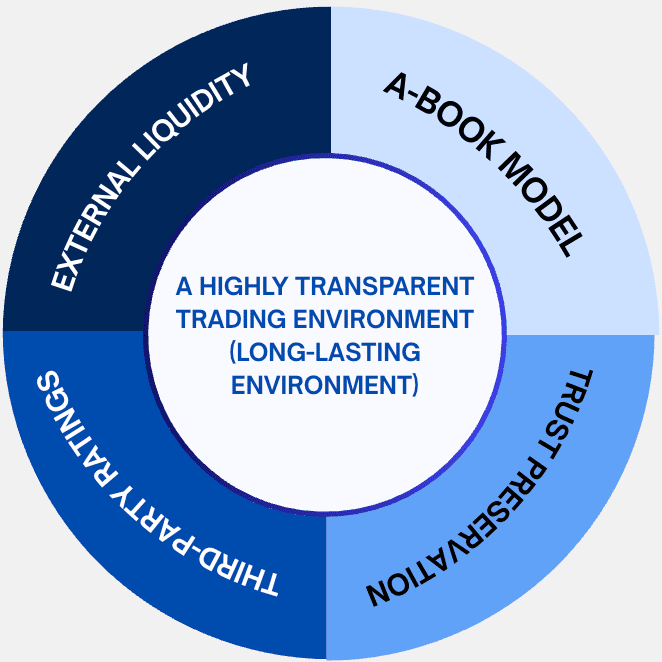

Commitment to Supporting a Trustworthy Trading Environment
・A-Book Model
・Third-Party Ratings
・Cash Management with Trustee Protection
・Access to External Liquidity
We believe that maintaining a transparent trading environment is important for all traders, IBs, and brokers. We value long-lasting relationships.