
Why Hirose Is a Trusted Broker
An Unmatched, Highest Level of Safety

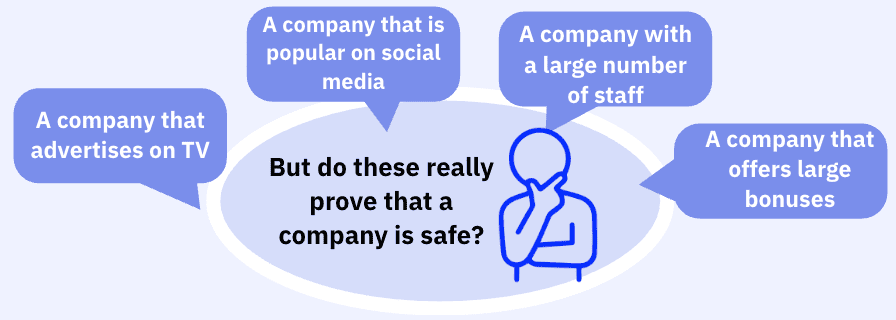
For IBs who want to build a long-term business, choosing a broker based only on short-term conditions is risky.
To succeed in the long run, you must partner with a broker that is stable and reliable over time.
So the question becomes:
How can we objectively determine whether a company is truly trustworthy?
The 4 Conditions of a Truly Reliable Broker
The number of advertisements or popularity on social media does not accurately reflect the safety or stability of an FX broker.
What truly matters is information that has been objectively verified by independent third parties.
To determine whether a broker is truly trustworthy, the following four key factors should be considered.
 Financial Transparency (Independent Audit)
 Third-Party Credit Evaluation (Credit Rating)
 Client Fund Protection (Trust Preservation)
 Transparent Trading Model (A-Book)
Hirose is a broker that meets all four of these standards, representing the highest level of safety in the industry.
 Financial Transparency – What is an Audit Firm?
An audit firm is an independent professional organization that verifies whether a company’s financial statements are properly prepared, free from fraud or manipulation, and compliant with applicable accounting standards.
Audit firms review financial reports prepared by the company from an independent standpoint.
If no issues are found, they issue an Audit Opinion confirming the reliability of the financial statements.
Credit rating agencies then evaluate companies based on these audited financial data.
Hirose is one of these companies.
This means that its financial information and corporate management are continuously reviewed and verified by an independent third party.
Reliability of
Financial Information
Financial statements are verified by an independent third party, increasing the credibility of the company’s financial information.
Maintaining
Transparency
Demonstrates that the company maintains a certain level of transparency and has systems capable of withstanding external review.
Proof of Social
Credibility
Being audited itself serves as evidence of the company’s reliability and long-term credibility.
regarded as more transparent and trustworthy.
The Big Four – The World’s Leading Audit Firms
The Big Four audit firms are globally recognized organizations that audit listed companies and major financial institutions around the world.
Japanese Audit Firm  |
Global Network  |
|---|---|
| EY ShinNihon LLC | Ernst & Young(EY) |
| Deloitte Tohmatsu LLC | Deloitte |
| KPMG AZSA LLC | KPMG |
| PwC Japan LLC | PricewaterhouseCoopers(PwC) |
- Global networks spanning 150–170 countries
- Responsible for auditing the majority of publicly listed companies
- Trusted by many multinational corporations
- Provide audit, tax, and consulting services
- Represent over 70% of the global audit market

| Company | Industry | Audit Firm |
|---|---|---|
| Vingroup | Conglomerate | Ernst & Young (EY) |
| Vietnam Airlines | Aviation | KPMG |
| FPT Corporation | Information Technology | PricewaterhouseCoopers (PwC) |
| Bao Viet Holdings | Insurance | Ernst & Young (EY) |
| VietinBank | Banking | Deloitte |

| Company | Industry | Audit Firm |
|---|---|---|
| Apple | Technology | EY |
| Microsoft | Technology | Deloitte |
| Toyota Motor Corporation | Automotive | PwC |
| HSBC | Banking | KPMG |
 Hirose Tusyo Inc. Hirose Tusyo Inc.
|
FX Brokerage | Deloitte Tohmatsu |
 Third-Party Evaluation – What is a Credit Rating?

Definition of a Credit Rating
A credit rating is a system in which an independent third-party rating agency evaluates a company’s creditworthiness based on financial data and clearly defined evaluation criteria.
Because these ratings are assessed using globally recognized standards, having a credit rating means that the company has been evaluated according to international credit assessment standards.
What Do Credit Ratings Evaluate?
Risk Management
Framework
- Market risk management
- Counterparty risk management
- Capital management systems
Payment Capacity
- Ability to meet obligations to clients
- Liquidity position
- Ability to handle short-term liabilities
Financial Stability
- Capital adequacy
- Soundness of net assets
- Stability of earnings
- Ability to generate sustainable profits
Management Stability
- Stability of the business model
- Market position
- Brand credibility
Business Continuity
- ong-term business strategy
- Stability of the corporate group structure
- Track record and years of operation
Credit ratings evaluate these stability factors comprehensively.
IB business is not a short-term game.
The real question is whether the company you introduce will still exist three or five years from now.
Credit ratings are one of the key indicators used to measure that long-term stability.
Trust Should Be Judged by Objective Information,
Not Popularity

Warning Signs of Corporate Failure Are Hard to See
When companies fail, it is rarely sudden.
In most cases, financial conditions gradually deteriorate over time.
However, much of this information remains internal and is often not visible from the outside. Behind the appearance of success, risks may be quietly accumulating.
📱 What You Cannot See from Social Media or Advertising


0

Because of this, corporate stability and credibility cannot be judged simply by popularity or advertising presence.
What Credit Ratings Really Prove

Independent Third-Party Evaluation
Specialized institutions with no conflict of interest evaluate a company’s creditworthiness from an objective and impartial perspective.

Objective Analysis
Based on Financial Data
Evaluations are based on numerical financial data, such as financial statements, rather than emotions or impressions.

Disclosure of
Evaluation
Reasons
The reasons behind the rating are clearly disclosed, ensuring transparency in the evaluation process.
Therefore, it is possible to evaluate a company not only through third-party ratings, but also by reviewing publicly available information yourself.
Trust should not be judged by popularity, but by objective information.
Evaluated by the Same Global Standards
— That Is Real Trust
A credit rating is a “certificate of trust” recognized in the global financial markets.
It is not a company’s self-assessment, but the result of an objective evaluation conducted by an independent third-party rating agency.
Having a credit rating means that the company has passed strict evaluations based on global standards.
In other words, it is not the company saying “we are trustworthy,”
but rather being recognized as trustworthy by an independent third party.
Major banks
around the world
Large financial
institutions
Global corporations

Government organizations
in many countries

Evaluated Under the Same Standards Worldwide
Countries such as Japan, the United States, and Germany, as well as global banks and corporations, are evaluated under the same credit rating framework.
A Credit Rating Is Not Permanent
Obtaining a credit rating is not the end of the process.
If a company fails to maintain the required standards, its rating can be downgraded immediately.
This means companies must continuously maintain sound financial management and stable operations.
Multi-Layer Credit Verification Process
by Independent Third Parties
Company (Broker)
Financial information is prepared by the company

- Financial statements
- Financial reports
- Business data
Audit Firm
The audit firm reviews the data

- Audits financial data
- Checks for fraud or errors
- Verifies compliance with accounting standards
Credit Rating Agency
The rating agency evaluates the company

- Financial stability
- Profitability
- Risk management
Credit Rating Determined

BBB

Then, an independent audit firm reviews the financial data to ensure there are no errors or misconduct and that the information complies with accounting standards.
Based on the audited financial statements, credit rating agencies assess the company’s financial health, profitability, and risk management.
Financial audits conducted by independent audit firms
Evaluations performed by credit rating agencies
Hirose’s Consistent BBB
Credit Rating for 10 Consecutive Years
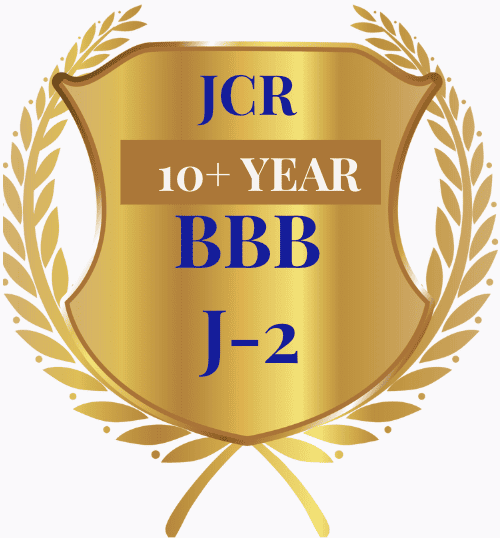
Hirose has maintained a BBB rating with a stable outlook for 10 consecutive years, as evaluated by the Japan Credit Rating Agency (JCR), an independent third‑party rating organization.
Non‑Rated Brokers vs. Rated Brokers
| Comparison Item | Brokers Without Ratings | Rated Brokers (Hirose) |
|---|---|---|
| Proof of Credibility | 🔸Only self-evaluation | ✅Evaluated by independent third-party agencies |
| Management Transparency | ❌No external oversight | ✅Regular reviews of financials and management |
| Advance Risk Warnings | ⚠️No early signals | 🔔Downgrades act as market-based warnings |
| Visibility of Market Evaluation | ❓Hard to assess | 📊Clearly shown through numerical ratings |
| Trust from External Financial Institutions | 💰May face higher interest rates | 🏦Evaluated based on established creditworthiness |
| Long-Term Stability | Uncertain | ⏳Assumed to be stable over the long term |
| Management Approach | Focus on short-term conditions | 🛡️Emphasis on long-term stability |
 Hirose further protects client funds
through a trust protection system
What Is Client Fund trust protection ?
Client funds are completely separated from the broker’s operational funds and managed by a third-party trust bank. Even if the broker were to become insolvent, client funds are returned directly from the trust bank to the clients.
Flow of Client Funds
(Normal Operation)
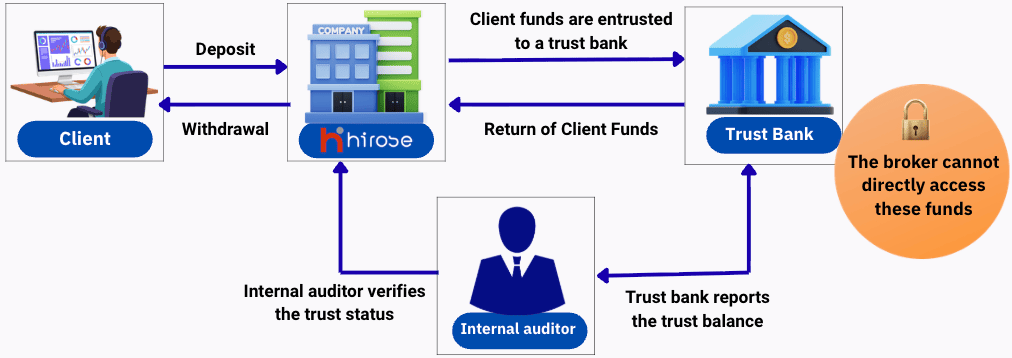
Flow of Client Funds in the Event of Broker Insolvency
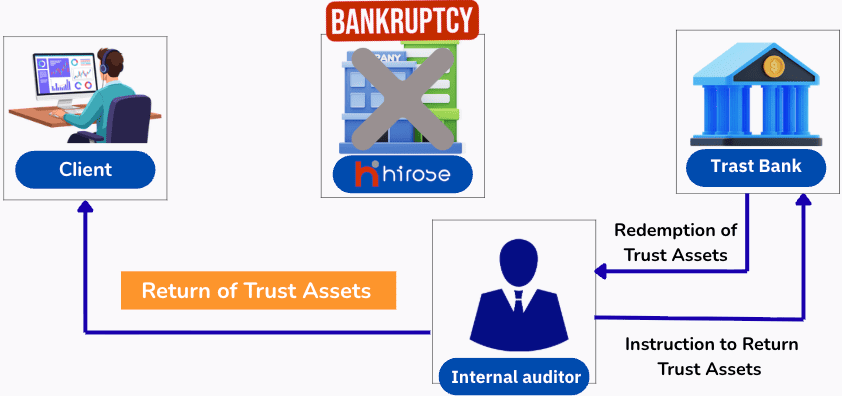
This eliminates the risk of misuse or misappropriation of client assets.
Segregated Accounts vs Trust Accounts

Segregated Accounts
Funds are separated but
still controlled by the broker.

The broker manages the client fund account, so funds can be moved by the broker.

If the broker becomes insolvent,client funds may not be fullyprotected.
Trust Accounts
Client funds are managed by an
independent trust bank.

Client funds are managed by a trust bank or trust company.
Therefore, the broker cannot access the funds.

Client funds are
returned in full.
Daily balance reconciliation by
the trust bank
Many overseas FX brokers adopt only segregated accounts.
However, Hirose adopts trust account protection to ensure the safety of client funds.
 Transparent Trading Model (A-Book)
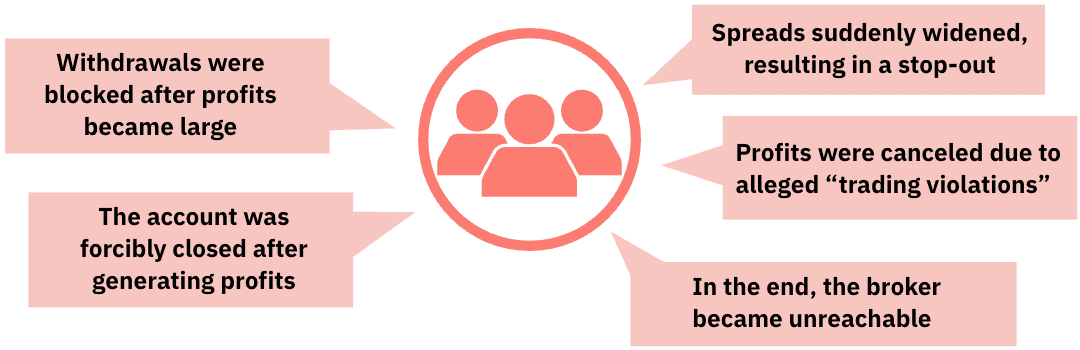
Hirose operates under an A-Book model and does not profit from client losses.
Prices are aggregated from multiple liquidity providers.
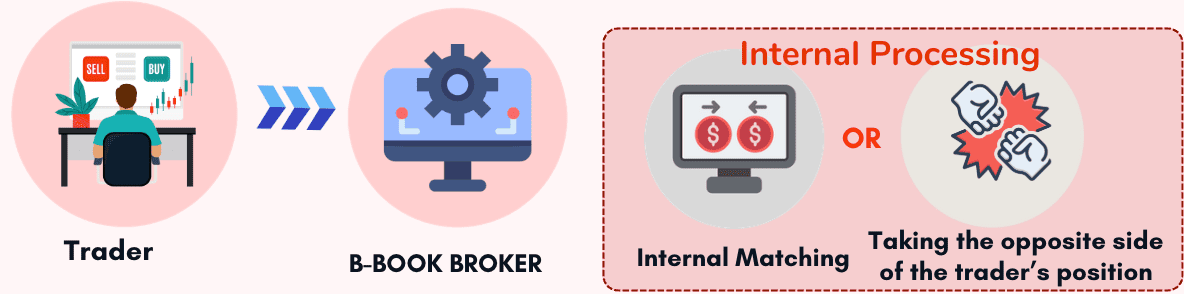
- Client losses = Broker profit
- Client profits = Broker loss
- Prices are controlled
by the broker - Withdrawal issues
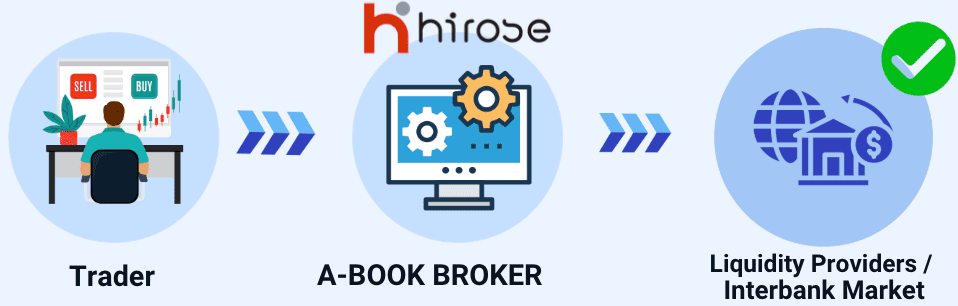
- Orders are connected directly to the interbank market
- Prices are derived from multiple liquidity providers (LPs)
- The broker does not profit
from client losses - High level of transparency
A-Book → A structure where client profits do not create a problem for the broker.
B-Book → A structure where client profits may create a conflict of interest.
Benefits for IBs Partnering with a Rated Company

Enhances the IB’s Credibility
When working with a company that has a credit rating,
IBs can explain the broker’s reliability based on an independent third-party evaluation, rather than personal opinion.

Ability to Entrust Client Funds with Confidence for the Long Term
Brokers chosen only for bonuses or short-term conditions may lose clients when those conditions change. Companies with verified financial stability allow IBs to build long-term partnerships with their clients.

Much Easier to Explain in Case of Issues
Questions about the safety of a company will always arise.
With a credit rating, IBs can explain using an objective third-party evaluation, rather than needing to personally guarantee the broker’s reliability.

Trust Becomes a Powerful Sales Advantage
Financial audits × Credit rating × Trust account protection × A-Book model
These elements provide objective credibility for building a successful long-term IB business.
Security That Lasts — Not Just High Conditions
Trust is not determined by promises alone. It is built through continuous evaluation by independent third parties.Hirose values not short-term conditions, but the ability to continue operating and reliably fulfill its obligations.
For Traders Who Want to Start
Trading with Confidence
- • Client funds separated from company funds
- • Transparency through external audits
- • A reliable long-term trading environment
For IBs Looking for a Broker
They Can Recommend Long-Term
- • Explain your broker choice with objective evidence
- • Third-party credibility in case of issues
- • Confidence to entrust clients long-term