
Slippage & Spread Widening Understanding
Minimize Risk & Maximize Gains with Hirose

Ever found yourself wondering…
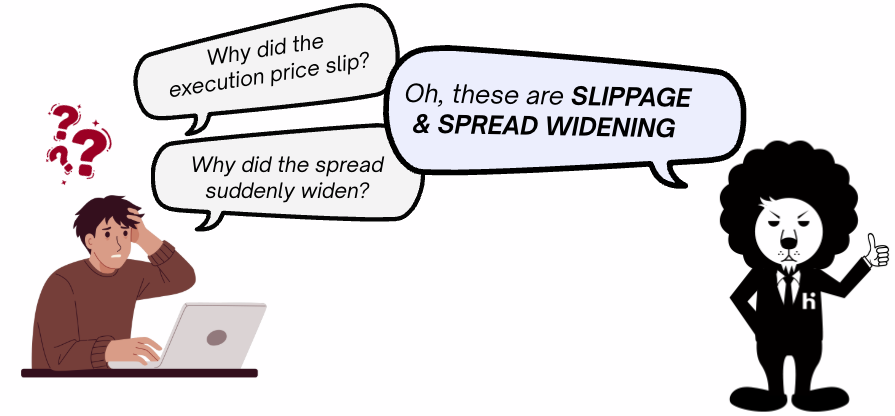
Let’s dive deeper into what causes slippage and spread widening, and explore practical ways to minimize their impact on your trading strategy.
Four Main Factors Affecting
Order Execution
Order execution speed and accuracy are critical in trading, especially in fast-moving markets like Forex. Several factors can influence how quickly and precisely your orders are filled.
 Letancy
Communication Speed (Latency) is the time it takes for an order to travel from trader’s device to the broker’s server. It is measured in milliseconds (ms).
IMPACT:

It’s easier for an order to be executed after the price has already moved.

The execution price is much closer to the one you clicked.
 Physical Distance
The physical distance between the trader and the trading server.
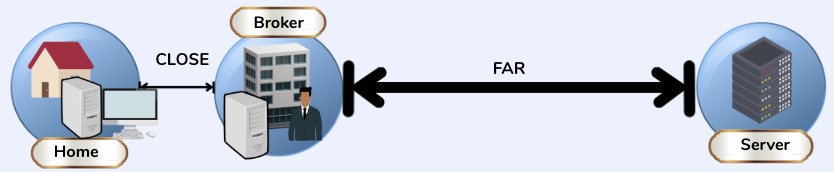
The farther the physical distance, the greater the latency tends to be.
 Server Processing Speed
The internal processing speed from the moment an order is received to when it is sent to the market.
This is where a broker’s infrastructure design capabilities are truly put to the test.
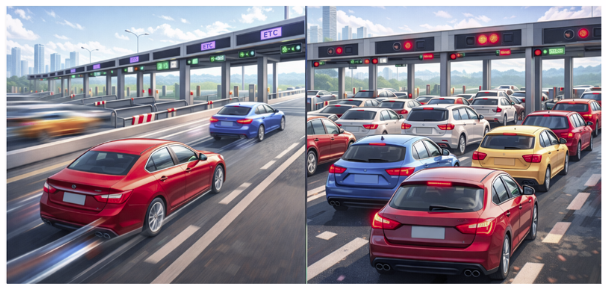
 Server Capacity
Server Capacity refers to the number of orders that can be processed simultaneously.
During major news events, the number of orders can increase dramatically during this time.
When orders concentrate during such times, and if capacity is insufficient, congestion may occur.
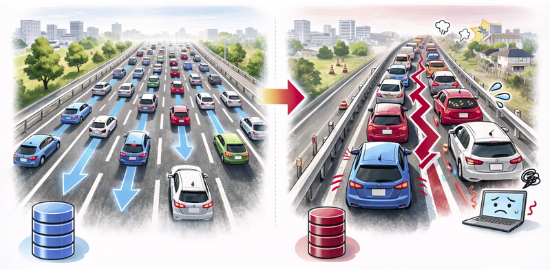
The more lanes there are, the more orders can be processed. If the capacity is small, congestion occurs.

The secret behind prices
changing in a second
These execution-related factors above directly influence the speed at which rates are received, processed to determine
the best bid and ask, and displayed on trading platforms – which is why prices can vary from broker to broker.
Because both the number of executions per second and the rates themselves differ.
WHY IS
THIS?
Each second, the system instantly checks the rates from all partnered banks and selects the best one.
Since these rates are updated continuously, the execution price changes constantly – occurring at speeds as fast as the
millisecond level.

Hirose sources hundreds of rates per second from 20+ liquidity providers, instantly selecting the best available price
to ensure highly competitive quotes.
The more rates received, the greater the ability to offer highly competitive pricing.
XAU/USD
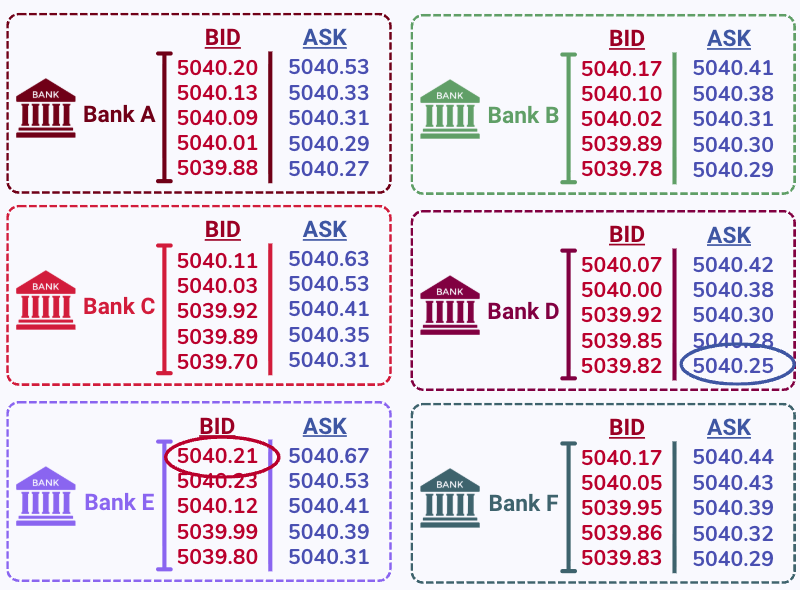
At Hirose, we select the best Bid and Ask from a wide range of rates to offer you the most competitive prices. For more details, please refer to the page below.
WHAT IS SLIPPAGE?
Slippage happens when your trade is executed at a different price than you expected. This could happen within a second as you enter a position or when closing a position.
This can also happen on any market, such as Forex, shares, or indices, when trading CFDs.
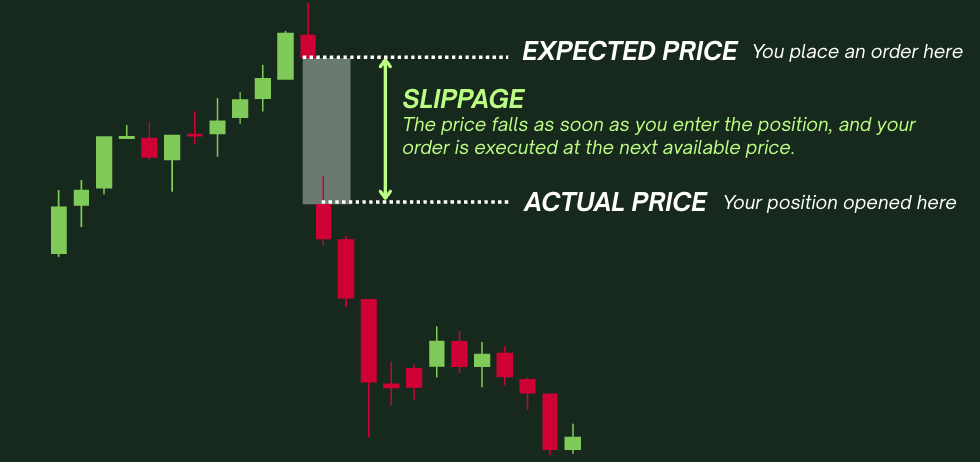
When does slippage occur in trading?
-
ORDER TYPE

Market Order Option
Market orders prioritize speed over price, so they’re more likely to experience slippage. -
EXECUTION SPEED

Delayed Execution Speed
Even a slight delay between placing and executing an order can lead to a different fill price, especially in fast-moving markets. -
MARKET CONDITIONS

High Market Volatility
Sudden price movements, often during major news releases or economic events, can cause prices to move before your order is filled.
Low Liquidity
During off-peak hours or in less active markets, there may not be enough buyers or sellers to match your order at the expected price.

Trade with Confidence – Hirose Delivers Speed and Stability
With one of the fastest execution speeds in the industry, Hirose empowers traders to stay ahead.
Slippage may not be completely avoidable, but Hirose’s outstanding execution speed makes it possible to minimize its impact.
We proudly leverage advanced cloud technology to enhance the scalability and performance of our FX systems. This is the reason why our platform achieves industry-leading execution speeds.
This technological edge has led to higher customer satisfaction, both in Japan and around the world.
WHAT IS THE WIDENED SPREAD?
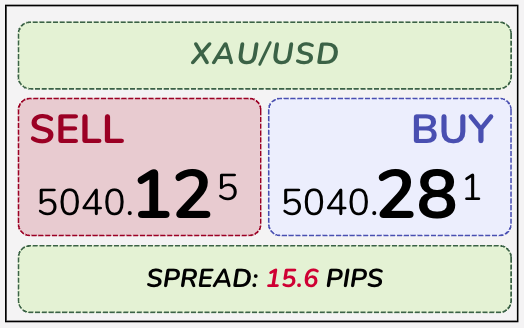
A widened spread happens when the difference between the bid price (what buyers are willing to pay) and the ask price (what sellers want) becomes larger than usual. This means the cost to enter or exit a trade increases – less favorable for traders.
NORMAL SPREAD
WIDE SPREAD
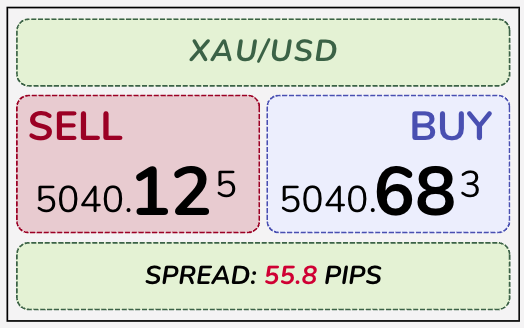
For example, you may want to buy XAUUSD with a spread of 15.6 pips, but just when you’re about to click BUY, the U.S. unemployment report will be released and the spread rapidly widens to 55.8 pips!
HOW DOES
IT HAPPEN?
The chart below shows the distribution of orders for XAU/USD and the spread widening before the news.
Let’s say the current XAUUSD rate is 5040.
Before an major news release, since it’s unclear which direction the market will move, traders hold back on placing orders, leading to a decrease in order volume (a drop in liquidity).
- Traders tend to refrain from placing new orders as they wait for the news to be released.
- As liquidity decreases, the number of available prices at which trades can be executed also declines.
Due to the drop in liquidity before a news release, the gap between buy and sell orders widens, causing the spread between the Bid and Ask prices to increase.
This is the mechanism and reason behind spread widening. Spread expansion is a normal part of market dynamics that occurs in response to factors like news events or reduced liquidity.
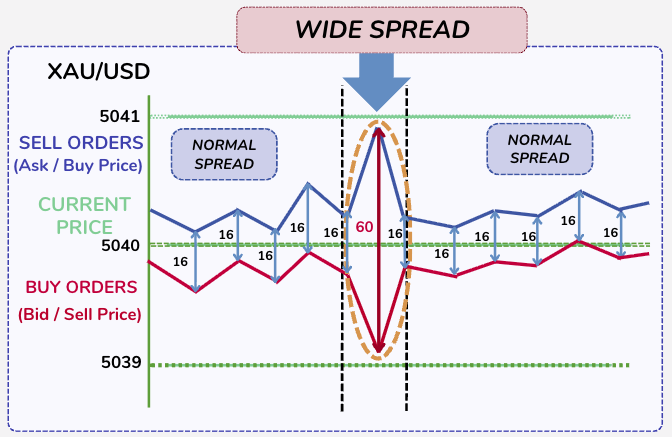
Orders distribution
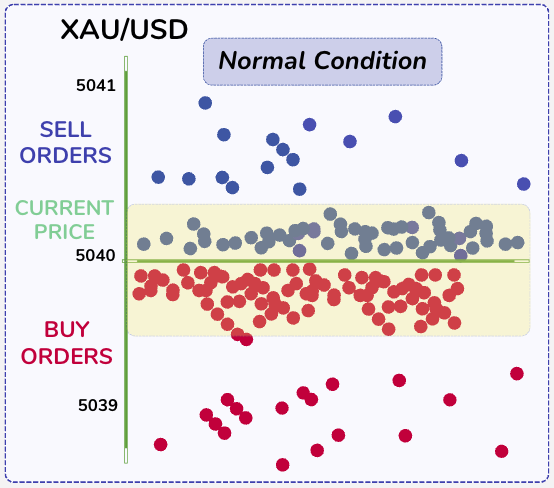
price movements are predictable, so there is a high volume of orders near the current rate.
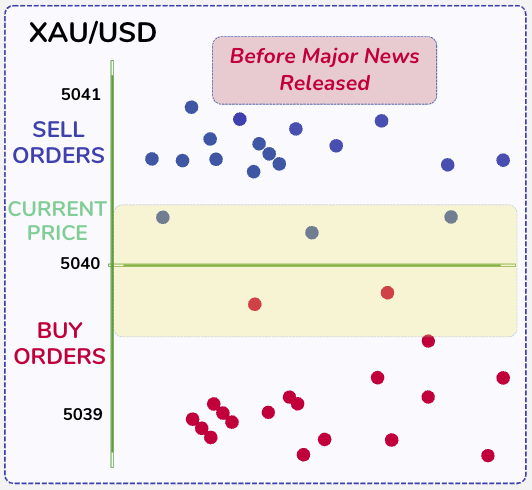
it’s unclear which way the market will move, so traders hold back on orders, causing liquidity near the current rate to drop significantly.
Ever wondered why spreads suddenly widen,
even with a trusted A-Book broker?
Let’s dive into the key moments when this happens – especially from an A-Book broker’s perspective, where trades are passed directly to the market or top-tier liquidity providers.
-

Market Volatility
Sudden price movements increase risk in trading market. Hirose doesn’t interfere, so traders see the real-time impact. -

Low Liquidity
During off-peak hours or in less active markets, there may not be enough participants. With reduced market depth, wider spreads naturally occur. -

During Major Economic Events
When news hits (like NFP, CPI, or central bank decisions), spreads are naturally widen, so Hirose’s spreads widen too.
Thinly Traded Instruments
Exotic currency pairs or low-volume assets often have fewer orders placed, which naturally results in wider spreads.
Because A-Book brokers LIKE HIROSE don’t manipulate spreads, what you see is what the market OFFERS: pure & transparent pricing.
If you want to learn more about the differences between A-Book and B-Book please click here:
Why Do A-Book Brokers Show Wider Spreads & Slippage,
While Some B-Book Brokers Don’t?
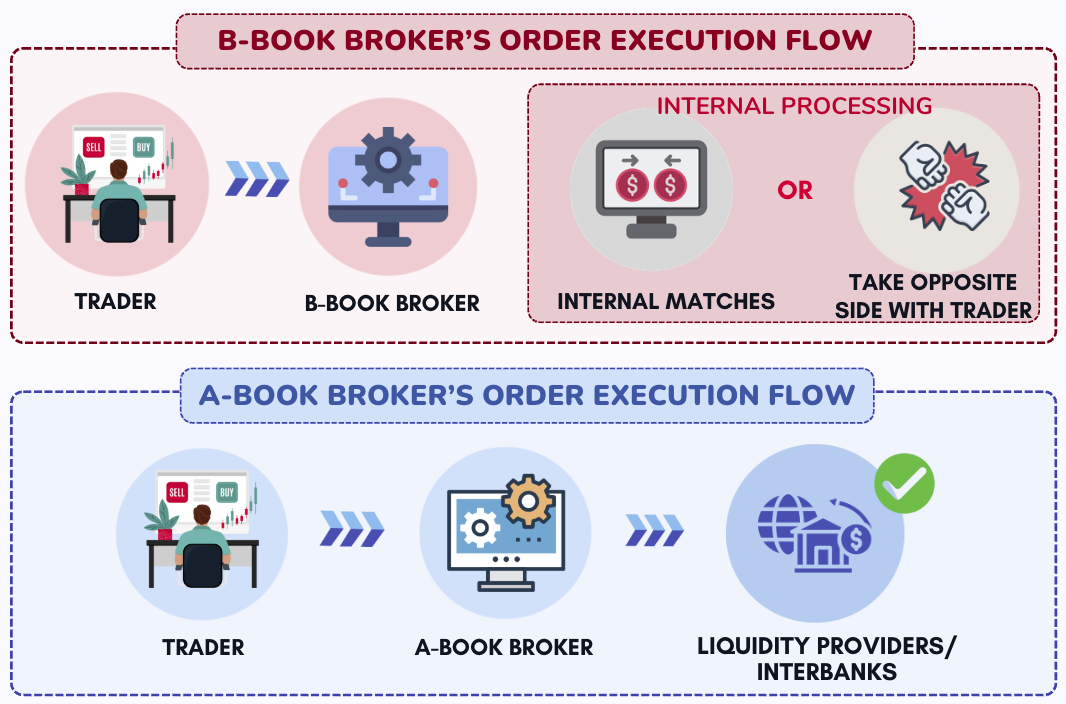
the Trading Environment
B-Book brokers process orders in-house. They take the opposite side of your trade and don’t send it to the market.
During Major Economic Events:
- Stable spreads or reduced slippage are possible, but they do NOT necessarily reflect true market stability.
- In a B-Book model, brokers process orders internally; because pricing and execution are based on internal risk management policies, the stability provided may differ from actual market conditions.
- Since execution and price updates depend on internal policies, it is essential to choose a broker based on a thorough understanding of their specific execution model and structure.
Traders are trading against the B-book broker, not the market!
Reflect Real Market Conditions
A-Book brokers, like Hirose, pass 100% of your orders directly to liquidity providers or the interbank market.
Therefore, they reflect the real market conditions.
During Major Economic Events:
- Because of the market’s volatility. Hirose doesn’t interfere, so traders see the real market conditions.
- Orders may experience slippage or delays due to external factors like High Market Volatility and Low Liquidity.
- It means you get true market pricing with no hidden fee, but with real-time opportunities and risks.
Traders are trading against the market, not the broker!

Be Cautious of “Too Good to Be True” situation!
If spreads stay tight and there’s zero slippage – even during major news events – it might not reflect real market conditions. Some B-Book brokers may offer artificially stable conditions by internalizing trades, potentially creating a conflict of interest.
Common real-world problems
- Account restrictions when you start making profits: Trading conditions may be changed by citing reasons such as “scalping is prohibited” or other trade restrictions.
- Delayed withdrawals or withdrawal refusal: Withdrawal processing may be halted by requesting additional documents or citing certain terms and conditions.
- Cancellation of part of your profits: Profits may be invalidated for reasons such as “rule violations” or “pricing errors.”
At Hirose, we believe in real market access, honest pricing, and building trust through transparency.
HOW TO MINIMIZE THE IMPACT OF SLIPPAGE & SPREAD WIDENING?
Trade During High Liquidity Hours
Stick to major market sessions (like London or New York open), when market activity is at its peak and spreads are typically tighter..
Avoid Trading During Major News Releases
these events often trigger sharp price movements and increased volatility, leading to slippage and wider spreads.
Use limit orders instead of market orders
Limit Orders can help you to maintain control over your entry price and avoid unexpected fills during fast-moving markets.

Choose a transparent broker like Hirose
Hirose reflects real market conditions by executing trades directly through top-tier liquidity providers, ensuring fast execution with no hidden manipulation.